SIX CORE ITEMS
The FARPET looks at six constructs core to any higher education learning environment: Lesson Structure, Content Organization, Audiovisual Facilitation, Concept Development, Enthusiasm, and Relevance.
Context-Specific Additions
In addition to the core items, the tool is intended to flex according to the specific context for teaching and learning. In the first version of the tool (currently available), this denoted “Asynchronous” and “Synchronous” lessons, with different items added to the core six that described key aspects of the context.
Asynchronous
Synchronous
- Lesson Structure
- Content Organization
- Audiovisual Facilitation
- Concept Development
- Enthusiasm
- Relevance
- Cognitive Engagement (Asynch)
- Lesson Structure
- Content Organization
- Audiovisual Facilitation
- Concept Development
- Enthusiasm
- Relevance
- Cognitive Engagement (Synch)
- Discourse Quality
- Collaborative Learning
- Check for Understanding
As we further develop the tool, we will be honing in on critical aspects of clinical and small-group teaching that will become their own context-specific additions.
Rubric
Observers rate what they see in the lesson from 1 (low quality or no presence) to 5 (highest quality and/or consistently present) for each item. The low (1), medium (3) and high (5) levels contain descriptors of what the observer should expect to see at that level of quality and consistency. This scaffolds observer ratings, improves consistency between raters, and – most importantly – supports discussion during the post-observation feedback session.
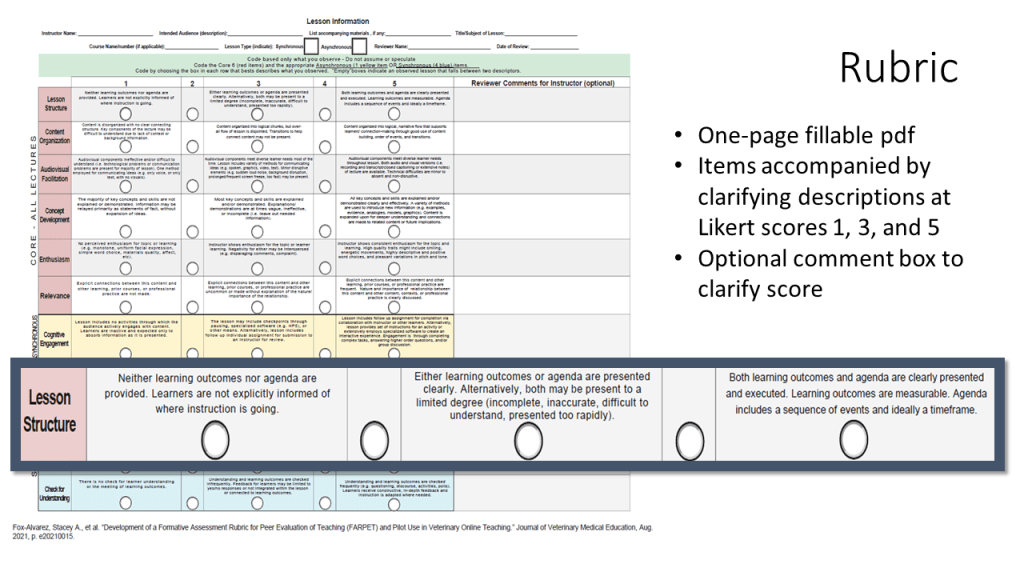
Using this rubric, the observed educator can clearly understand why they got the rating they did, and immediately see how they could teach better.
Comment Boxes
Space is left at the end of each item for the observer to take notes, explain, or expand on something they noticed. These comment boxes are more than an afterthought! They complement the rubric by providing supporting reasoning and beginning the formative feedback conversation.
Testimonials
“The rubric helped me to think critically about their methods and goals for the session. Without that structure, I would have been much more likely to view their success as something innate as opposed to something that is intentional, measurable, and achievable for folks like me.”
Dr. Derek Foster, NC State University
“Seeing the different rubric components and descriptors made me reconsider how I could improve my own teaching practice.”
Dr. Jo Smith, University of Georgia
“My first formal teaching evaluation (not FARPET) I got a kind of Likert-scale check-list on a sheet that appeared to have been photocopied from an original created in the 80s… Formative feedback was almost non-existing and consisted of a ‘good job’ and ‘speaks fast.’ It was not particularly helpful or surprising!“
Dr. Bobbi Conner, University of Virgina-Maryland
 Formative Assessment Rubric for Peer Evaluation of Teaching (FARPET)